

Views: 0 Author: Site Editor Publish Time: 2026-09-23 Origin: Site


Imagine a bustling city grid or a high-speed data center. None of these infrastructures function without miles of perfectly insulated cables. At the heart of this massive manufacturing process lies the wire and cable extruder. This sophisticated industrial machinery seamlessly coats bare conductors with protective jackets. For facility managers and production engineers aiming to scale operations while minimizing material waste, grasping the exact mechanics of these systems is non-negotiable. This comprehensive guide breaks down the operational intricacies of extrusion technology. We will explore core components, troubleshoot common defects, and evaluate the strategic advantages of upgrading to specialized equipment.
A wire and cable extruder operates through a continuous industrial process of melting plastic pellets and coating them over a moving bare wire core.
Core mechanical components include the material hopper, heated barrel, rotating screw, crosshead die, cooling trough, and capstan take-up system.
Investing in high-efficiency machinery significantly reduces factory energy consumption and improves the precision of the insulation thickness.
A dedicated sheathing line is essential for applying the final durable outer jacket that protects inner cable cores from environmental damage.
Modern manufacturing facilities are shifting toward high-output systems equipped with intelligent automation to maximize production returns and minimize downtime.
Fundamentally, a wire and cable extruder is a heavy-duty industrial manufacturing system. It is designed to apply a continuous and uniform layer of plastic insulation over a conductive wire or fiber optic core. Facilities use these machines to process raw copper for residential wiring or delicate glass fibers for telecommunications. The primary objective remains constant across applications: providing essential electrical insulation, physical protection, and environmental resistance. On the factory floor, a bare copper wire races through a crosshead at high speeds and is instantly enveloped in a flawless layer of molten polymer. Without this precise application, cables would quickly succumb to moisture, mechanical stress, and chemical degradation.
Looking at the broader manufacturing landscape, the global push toward renewable energy, smart grids, and electric vehicle infrastructure has dramatically altered production demands. These modern applications require high-voltage, low-loss cables manufactured to incredibly strict dimensional tolerances. Consequently, the extrusion industry is experiencing a rapid shift toward automated, data-driven manufacturing. Modern facilities are abandoning manual adjustments. Instead, they favor intelligent systems that continuously monitor melt pressure, temperature zones, and line speed in real-time. This evolution ensures strict compliance with international safety standards. Furthermore, it significantly boosts overall factory throughput, making an in-depth understanding of advanced extrusion mechanics more critical than ever for production engineers.
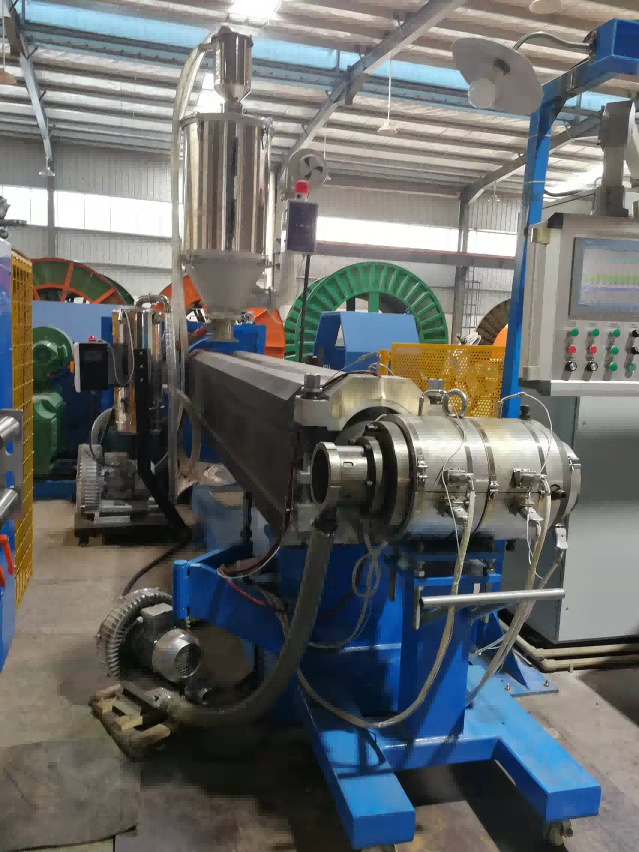
To truly understand how the extrusion process works, engineers must break down the anatomy of the machine. The equipment relies on a series of synchronized mechanical components that transform solid plastic resins into a precise, flexible coating.
The entire process initiates at the feeding hopper. This component acts as a funnel where raw thermoplastic materials, such as Polyvinyl Chloride or Cross-linked Polyethylene, are loaded in pellet form. Advanced hoppers often feature gravimetric dosing systems. These systems precisely weigh and mix the base polymer with color masterbatches before feeding them into the machine. For hygroscopic materials, the hopper typically includes an integrated drying mechanism. Removing moisture at this stage prevents microscopic structural defects in the final insulation.
The extruder screw and the heated barrel form the mechanical heart of the operation. As pellets drop from the hopper into the feed throat, they are aggressively pushed forward by a rotating helical screw housed within a robust steel barrel. The barrel is equipped with multiple electrical heater bands that gradually increase in temperature. However, the intense mechanical friction and shear forces created by the rotating screw generate the majority of the heat required to melt the plastic. The specific geometry of this screw, including its length-to-diameter ratio, is carefully engineered. This ensures the plastic transforms into a homogenous, viscous fluid by the time it reaches the end of the barrel.
Once the plastic is fully melted and pressurized, it is forced through a screen pack and enters the crosshead. This heavy-duty component changes the direction of the polymer flow, typically aligning it 90 degrees with the bare wire passing through the machine. Inside the crosshead lies the precision tooling: the tip and the die. The bare wire passes through the center of the tip, while the molten plastic is forced around it. The die dictates the exact outer diameter and shape of the extruded coating. Precision engineering here is absolutely critical for maintaining perfect concentricity.
Immediately after exiting the crosshead die, the newly coated wire is scorching hot. The plastic remains incredibly soft and vulnerable. If handled improperly at this stage, the insulation would instantly deform. To prevent this, the wire plunges into a long cooling trough filled with water. This cooling process is staged across multiple temperature zones. Gradual thermal extraction prevents the plastic from shrinking too rapidly. Rapid shrinkage could otherwise induce internal stresses or microscopic voids within the insulation layer.
The movement of the wire through the entire extrusion line is governed by the capstan. This motorized pulling mechanism grips the cooled cable and pulls it at a highly consistent velocity. It maintains strict tension throughout the high-speed process. Following the capstan, the finished cable is guided onto a take-up spooler. This spooler utilizes traversing mechanisms to wind the product evenly across the reel, preparing it for immediate shipping or further processing.
The actual manufacturing sequence requires precise mechanical synchronization. The operation begins when thermoplastic pellets cascade from the hopper into the extruder feed throat. Simultaneously, at the opposite end of the production line, a motorized pay-off stand unspools the bare conductor. Before this metal core reaches the plastic, it passes through an inline pre-heater. Elevating the temperature of the copper or aluminum is a critical preparatory measure. It drives off residual surface moisture and mitigates thermal shock. This ensures optimal adhesion between the cold metal and the impending hot polymer jacket.
As the wire is prepped, the rotating screw aggressively conveys the plastic pellets forward. The synergistic effect of external heaters and internal mechanical shear melts the polymer into a uniform fluid. Pushed into the crosshead, this pressurized melt is forced through the die to perfectly envelop the pre-heated wire. Immediately upon exiting the tooling, the hot cable plunges into the staged water cooling trough. This rapid thermal extraction crystallizes the plastic and locks in its dimensional stability. Finally, before being spooled, the cable passes through inline testing equipment. A laser diameter gauge continuously monitors the outer thickness. A spark tester applies high voltage to detect any microscopic pinholes, ensuring only flawless cable reaches the take-up reel.
Primary insulation safeguards the conductive core from electrical faults. However, many industrial and outdoor applications demand a secondary, highly durable barrier. Primary insulation is typically thin and designed strictly for dielectric strength. In contrast, the outer sheathing is the final protective layer. It is engineered to withstand severe environmental hazards such as ultraviolet radiation, chemical exposure, and heavy mechanical abrasion.
Because these sheathing compounds are inherently tougher and applied over a much larger diameter, the processing equipment must be explicitly built for the task. A dedicated cable sheathing extruder operates on the same fundamental thermodynamic principles as a primary line but features a significantly larger barrel, often 120mm or 150mm in diameter. These robust machines are capable of enveloping multiple twisted inner cores simultaneously. They maintain consistent melt pressure even when processing massive volumes of tough, heavy-duty polyurethane or low-smoke zero-halogen materials.
Operating legacy machinery in today's tight-margin manufacturing landscape is a hidden drain on profitability. Modernizing the factory floor yields immediate, measurable dividends across three critical operational pillars: energy conservation, material optimization, and intelligent automation. Older systems frequently rely on inefficient direct current motors and degraded heater bands that bleed electrical energy. Modern setups utilize advanced alternating current variable frequency drives and optimized barrel insulation. These upgrades convert electricity into mechanical torque with minimal thermal loss.
Furthermore, raw polymer resin constitutes a massive portion of ongoing operational expenses. Standard machines prone to pressure fluctuations often force operators to over-insulate cables just to guarantee minimum thickness compliance. By deploying a high-efficiency wire and cable extruder, facilities benefit from closed-loop feedback systems. These intelligent controls constantly adjust line speeds based on real-time laser diameter readings. This precise control keeps the jacket thickness at the absolute minimum tolerance, saving thousands of pounds of raw material annually.
Performance Metric | Legacy Extrusion Lines | High-Efficiency Systems |
|---|---|---|
Energy Consumption | High thermal loss, inefficient DC motors | Up to 30% reduction via AC drives & optimized heating |
Material Waste | High (operators over-insulate to meet specs) | Minimal (closed-loop laser diameter control) |
Automation Level | Manual adjustments, high reliance on operator skill | PLC-driven, recipe storage, automated fault detection |
Concentricity Precision | Prone to drifting at high speeds | Ultra-stable due to precision crosshead tooling |
For facilities aggressively scaling their market presence, increasing throughput without sacrificing structural integrity is the ultimate engineering challenge. High output does not simply mean cranking up the screw RPM. Doing so on standard equipment would inevitably scorch the polymer or cause severe surface defects on the cable. Instead, a true high-output wire and cable extruder is built from the ground up with optimized screw geometries. These designs melt plastics rapidly while safely managing intense thermal loads.
To sustain extreme velocities, these systems incorporate extended, multi-zone cooling troughs and heavy-duty chillers. Maintaining perfect concentricity at speeds exceeding a thousand meters per minute requires immense structural rigidity in the machine frame to eliminate micro-vibrations. The return on investment for such high-capacity lines is typically realized in record time. The initial capital expenditure is quickly offset by the exponential leap in daily production volume and the subsequent drop in per-unit manufacturing costs.
Even the most sophisticated manufacturing lines occasionally encounter operational anomalies. When a defect arises, relying on systematic data rather than operator guesswork is the fastest route back to peak production. One of the most pervasive challenges is poor concentricity, where the copper core drifts off-center within the plastic coating. This structural weakness usually stems from a misaligned die within the crosshead or erratic tension from the pay-off spool. Operators must utilize inline gauges to monitor this in real-time and adjust crosshead bolts to exact torque specifications to recenter the polymer flow.
Another frequent headache is surface roughness, often manifesting as a textured shark skin finish or microscopic pimples along the jacket. Roughness typically indicates that the polymer melt is too cold and struggling to flow smoothly through the tooling. Conversely, pimples almost exclusively point to moisture trapped within the raw resin pellets. When damp material hits the heated barrel, the moisture flashes into steam, creating tiny bubbles that burst upon exiting the die. Implementing a strict preventative maintenance protocol, such as regularly cleaning the screw and calibrating thermocouple sensors, will drastically reduce these costly defects.
Procuring the correct machinery demands a rigorous evaluation of your current product portfolio and future scalability. First, scrutinize your primary material requirements. Processing standard PVC involves entirely different shear dynamics than working with specialized cross-linked polyethylene compounds. This dictates specific screw compression ratios and barrel heating capacities. Ensure the equipment you select is metallurgically engineered for your primary resins.
Next, align the equipment mechanical capacity with your target output. If your facility produces high volumes of residential wiring, line speed is your primary metric. Conversely, wrapping thick, multi-core industrial power cables necessitates massive torque and specialized tooling. Finally, prioritize intelligent automation. Transitioning to Industry 4.0 standards reduces reliance on manual intervention. Equipment featuring sophisticated programmable logic controllers, akin to an intelligent extruding line for cable sheathing, ensures repeatable precision across diverse product runs. This ultimately safeguards your bottom line against material waste and human error.
The transformation of raw thermoplastic resin into a durable, life-saving cable relies entirely on precise industrial engineering. Mastering the intricacies of the extrusion process empowers manufacturers to elevate their product quality and operational efficiency. In an era where material costs and energy consumption dictate market competitiveness, clinging to outdated technology is a strategic misstep. By carefully evaluating production needs and investing in modernized, high-efficiency equipment, facilities can minimize downtime, slash waste, and confidently meet the surging global demand for superior cable infrastructure. To scale your production capabilities with industry-leading machinery, explore the comprehensive solutions at Anhui SJ and tailor a system to your specific operational goals today.
These machines are highly versatile and can process a wide variety of thermoplastic and thermosetting materials. Common materials include PVC and PE for standard electrical wires. For more demanding industrial applications, they process XLPE, Low Smoke Zero Halogen compounds, Polyurethane, and high-temperature fluoropolymers. The ability to process different materials depends heavily on the specific metallurgical design of the extruder screw and the heating capacity of the barrel zones.
The primary differences lie in energy consumption, material yield, and mechanical design. A standard machine may use older motors and basic relay controls, which lead to energy waste and output fluctuations. High-efficiency models utilize advanced servo motors, optimized screw geometries for faster melting with less shear friction, and sophisticated PLC systems. These upgrades result in significantly lower electricity usage and precise die controls that prevent over-insulating.
Line speeds are entirely dependent on the diameter of the cable being produced and the cooling characteristics of the polymer. For very fine gauge wires used in automotive or telecommunication applications, a high-output machine can achieve speeds exceeding 1,000 meters per minute. To maintain quality at these extreme speeds, the equipment is engineered with high-RPM drives and multi-pass water cooling troughs to rapidly remove heat.
While some mid-sized extruders offer a degree of versatility through tooling changes, it is generally not practical or efficient for high-volume manufacturing. Primary insulation requires applying a thin layer of plastic over a single, small conductor at extremely high speeds. A dedicated sheathing machine is built with a larger barrel diameter and a massive crosshead designed to accommodate thick outer jackets over multiple twisted inner cores.
Cable diameter is controlled through a combination of precise tooling dimensions inside the crosshead and synchronized line speeds. Modern lines utilize an inline laser diameter gauge located just after the cooling trough. This gauge continuously measures the cable and sends real-time feedback to the PLC. If the diameter is too thick, the system automatically speeds up the capstan to draw the plastic thinner. If it is too thin, the capstan slows down, ensuring the dimensions remain within strict tolerances.
Microscopic voids, or bubbles, within the insulation are typically caused by moisture trapped in the raw polymer pellets. When hygroscopic materials absorb ambient humidity and are fed into the heated barrel, the water instantly vaporizes into steam. This steam becomes trapped in the molten polymer and creates voids as the plastic cools. To prevent this, facilities must use integrated hopper dryers to thoroughly remove moisture from the resin before it enters the extrusion process.