

Views: 0 Author: Site Editor Publish Time: 2026-09-30 Origin: Site


Are production lines bleeding capital due to excessive material waste? Modern cable manufacturing demands absolute precision, yet many facilities still rely on outdated machinery that triggers costly bottlenecks. Selecting the proper equipment guarantees high-speed production efficiency while aggressively safeguarding your profit margins. In this technical guide, plant managers and engineering decision-makers will learn exactly how to evaluate and specify the perfect extrusion setup. We will break down machine configurations, critical component metallurgy, and the hidden operational costs that drain profitability.
Material Dictates Machinery: Processing standard polyvinyl chloride requires entirely different screw geometries, Length-to-Diameter ratios, and heating profiles compared to running fluoropolymers.
System Synergy is Non-Negotiable: Auxiliary downstream equipment remains just as critical as the main drive for maintaining exact cable concentricity and preventing structural voids.
Niche Markets Demand Customization: Upgrading to specialized manufacturing lines empowers factories to tap into highly profitable sectors like aerospace wiring, medical micro-cables, and renewable energy grids.
Total Cost of Ownership Rules: When auditing equipment suppliers, procurement teams must prioritize energy efficiency, closed-loop automation, and preventative maintenance support over the initial sticker price.
The global push toward grid modernization and renewable energy infrastructure is fundamentally reshaping manufacturing requirements. Market data indicates a massive surge in demand for high-voltage direct current cables and specialized electric vehicle harnesses. This rapid electrification trend forces cable manufacturers to adapt their factory floors immediately. Facilities relying solely on legacy equipment find themselves unable to process the advanced, flame-retardant, and temperature-resistant polymers required by modern international standards.
Furthermore, stringent regulatory frameworks like RoHS and CE certifications now demand zero-tolerance quality control. Manufacturers are shifting away from manual adjustments toward smart factory integration. The integration of inline laser measurement and automated tension control is no longer a luxury; it is a baseline requirement for staying competitive against agile global suppliers. Upgrading extrusion capabilities is the only viable path to securing lucrative contracts in these emerging high-tech sectors.
The main extruder acts as the beating heart of any wire manufacturing plant. The decision to commission a specific production line extends far beyond a simple capacity upgrade. It directly dictates material yield, scrap reduction, and overall operational uptime.
An inferior or mismatched machine constantly battles temperature fluctuations and erratic screw RPM. These mechanical instabilities inevitably cause severe variations in insulation thickness. If the polymer coating runs too thin, the entire batch fails high-voltage spark testing. Conversely, if the insulation runs too thick, the factory effectively gives away expensive raw materials for free. Plant operators often waste valuable shift hours manually tweaking heater bands just to prevent polymer scorching.
Precise mechanical control drastically slashes scrap rates. Copper, aluminum, and specialty plastics account for the overwhelming majority of your manufacturing overhead. By specifying equipment with advanced closed-loop feedback systems, factories minimize waste during start-ups, color changes, and continuous high-speed runs. For engineering directors, investing in the correct machinery accelerates the return on investment by eliminating unplanned downtime and maximizing raw material utilization.
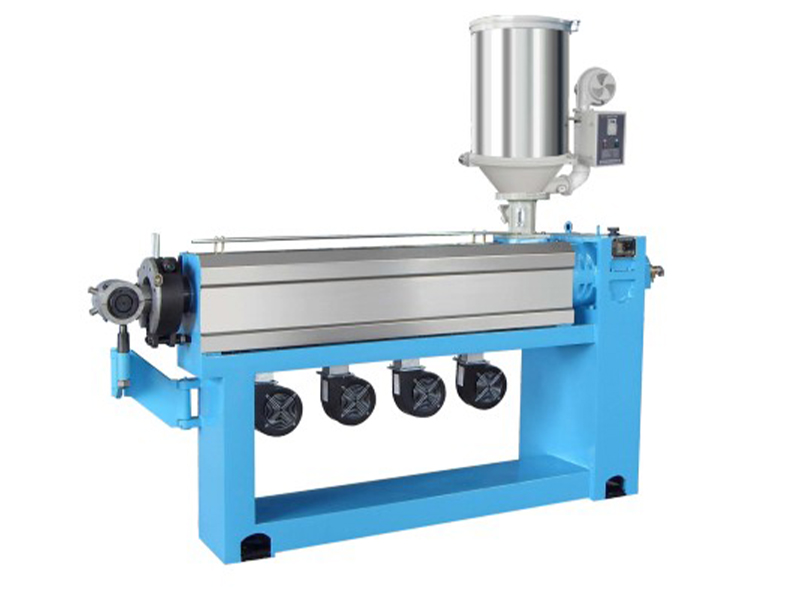
Specifying machinery starts with a rigorous analysis of the exact polymer compounds your facility intends to process. Utilizing a generic approach for diverse plastics guarantees sub-optimal throughput and premature gearbox failure.
Standard lines serve as the daily workhorses on the factory floor. They are engineered strictly for general-purpose plastics like Polyvinyl Chloride, Polyethylene, and Cross-linked Polyethylene. Facilities deploy these robust setups to manufacture building wires, low-voltage control lines, and standard power cables.
Take a typical high-performance sheathing line as a prime example. Equipment in this class, similar to an SJN-GX-150/25 setup, utilizes a 150mm screw diameter paired with a 25:1 Length-to-Diameter ratio. This specific geometry pushes output rates up to 600 kilograms per hour while maintaining a steady melt temperature around 180 degrees Celsius. Because standard plastics remain relatively chemically stable, the barrel and screw components rely on high-grade alloy steels like 38CrMoAlA with nitrogen treatment for wear resistance.
As industrial applications transition into extreme thermal environments, standard plastics melt and fail. Consequently, integrating a dedicated high-temperature setup becomes mandatory for aerospace, military, and 5G communication cables.
Fluoroplastics including FEP, PFA, and PTFE require aggressive processing temperatures exceeding 350 to 400 degrees Celsius. Standard steel components will rapidly corrode and degrade due to the hydrofluoric acid gas released during this process. Therefore, these machines feature specialized metallurgy. The screw, barrel, and crosshead are machined from corrosion-resistant superalloys like Hastelloy C-276 or Inconel. High-watt-density cast copper heaters replace standard aluminum bands to guarantee thermal stability at extreme heat.
Manufacturers targeting multi-layered or highly specialized profiles require bespoke equipment. Custom setups handle fiber optic micro-ducts, marine submersibles, or simultaneous multi-layer co-extrusion. These lines incorporate tandem extruders feeding a single precision crosshead, applying an inner semiconductor layer, primary insulation, and an outer color stripe in one continuous pass.
Extrusion Type | Typical Polymers | Operating Temp | Key Hardware Feature | Ideal Application |
|---|---|---|---|---|
Standard Jacketing | PVC, PE, XLPE | 150°C - 220°C | 38CrMoAlA Nitrided Steel, 25:1 L/D | Building wire, power cables |
High-Temperature | FEP, PFA, PTFE | 350°C - 400°C+ | Hastelloy Barrel/Screw, Cast Copper Heaters | Aerospace, EV harnesses, 5G |
Co-Extrusion / Special | LSZH, Multi-compounds | Variable | Tandem Extruders, Micro-adjustment Crosshead | Medical micro-cables, subsea |
An extrusion floor operates as a synchronized ecosystem. Plant engineers must scrutinize every mechanical link to prevent downstream bottlenecks.
The screw acts as the primary pump, responsible for shearing, melting, and conveying the polymer. Its design must perfectly match the specific polymer rheology. Processing highly viscous Low Smoke Zero Halogen compounds requires a lower compression ratio to prevent premature scorching. The barrel must feature high-efficiency ceramic heaters paired with localized cooling fans to hold melt temperatures within a strict one-degree tolerance.
The crosshead redirects the molten plastic at a right angle to coat the fast-moving copper conductor. Precision here dictates product viability. The die ensures absolute concentricity. Poor concentricity creates dangerous thin spots, leading to immediate electrical failure. Advanced tooling features self-centering mechanisms that maintain uniform wall thickness across hundreds of kilometers of continuous production.
Plunging a hot extruded jacket directly into chilled water is a rookie mistake. The resulting thermal shock locks in massive internal stress. You will inevitably see microscopic voids, severe shrinkage, or visible shape distortion once the product hits the spool. A properly engineered cooling trough for extrusion line prevents this disaster through segmented temperature gradients.
The initial zone utilizes warm water between 60 and 80 degrees Celsius to initiate gentle curing. Subsequent zones step the water temperature down gradually until the cable reaches ambient conditions. High-speed operations require trough lengths mathematically calculated against the line velocity and insulation thickness to ensure the core heat dissipates entirely.
Material handling dictates your continuous operational capacity. In highly efficient plants, dual-spooler take-ups with automated flying changeovers represent the industry standard. When one spool fills, the system cuts and transfers the wire to an empty reel in milliseconds without halting the main drive. Heavy-duty accumulators, commonly known as dancers, manage automated tension control to ensure delicate copper cores never stretch or snap during these aggressive transitions.
Drafting an equipment specification sheet requires aligning machinery capabilities with your daily production realities.
Factories rarely run a single plastic continuously. You must assess whether a machine can handle diverse compound changeovers. An optimal setup features interchangeable screw designs or a versatile barrier flight profile capable of processing standard PVC on Monday and tricky flame-retardant compounds on Tuesday without demanding a complete mechanical tear-down.
Production throughput is measured in meters per minute. While upgrading to a main drive capable of 1000 meters per minute sounds impressive, it is useless if your auxiliary systems cannot keep up. If the core output exceeds the cooling trough's chilling capacity or the take-up sensor's reaction time, you will generate scrap at record speeds.
Modern wire manufacturing relies entirely on closed-loop automation. Top-tier models utilize Programmable Logic Controllers paired with intuitive touch-screen interfaces. Look for systems that integrate inline laser diameter gauges and high-frequency capacitance monitors. If the laser detects the insulation running 0.02mm under spec, it automatically signals the drive to increase screw RPM instantly, correcting the flaw without human intervention.
The transition toward electric vehicles and high-density industrial automation demands cabling that survives brutal thermal environments. Standard setups are fundamentally useless here. Attempting to run fluoropolymers on a conventional machine results in severe thermal degradation of the plastic and catastrophic corrosion of the steel barrel.
To safely manufacture these advanced cables, plants must integrate a high-temperature wire and cable extruder. These highly specialized units utilize Proportional-Integral-Derivative temperature controllers to manage extreme heat profiles up to 450 degrees Celsius. Furthermore, the crosshead flow channels are heavily optimized to manage the unique melt flow index of Teflon-based materials, preventing material stagnation and internal burning.
Diversification mitigates market risk. While standard building wire provides steady volume, it suffers from razor-thin profit margins. Expanding into niche, high-barrier sectors like medical devices or offshore wind farms dramatically increases plant profitability.
Producing complex structures like flat ribbon designs or multi-layer power cables requires highly adaptable engineering. Investing in a special cable extrusion line provides the technical flexibility to meet non-standard military or medical specifications. These custom setups employ high-resolution laser gauges and ultra-sensitive tension controllers to prevent the snapping of micro-fine core wires. Collaborating with equipment engineers to design a tailored layout transforms your facility from a commodity supplier into a specialized engineering partner.
Procuring heavy industrial equipment impacts your Overall Equipment Effectiveness for the next fifteen years. The engineering depth of your supplier matters just as much as the steel they weld.
Avoid vendors pushing rigid, off-the-shelf solutions. A reputable manufacturer analyzes your exact wire recipes, target line speeds, and factory floor space before submitting a proposal. They provide empirical data justifying their chosen screw compression profiles based on your specific polymer blends.
Crucially, never sign off on a machine without a rigorous Factory Acceptance Test. This dynamic dry run occurs at the supplier’s facility using your actual copper and plastic pellets. Operators must verify insulation concentricity, diameter stability, and spark test pass rates at guaranteed maximum operational speeds before the equipment is ever crated for freight.
Procurement teams face immense pressure to select the lowest capital expenditure bid. However, the initial purchase price represents merely a fraction of the Total Cost of Ownership.
The most expensive recurring cost in cable manufacturing is the polymer itself. A cheap machine with unstable RPM produces fluctuating wall thicknesses. To avoid failing minimum thickness regulations, operators are forced to over-extrude, wasting massive volumes of expensive plastic every shift. A precision machine holds tight tolerances, saving hundreds of thousands of dollars in raw materials over its lifespan.
Energy efficiency also drives the Total Cost of Ownership. Modern setups utilizing high-efficiency AC motors, variable frequency drives, and heavily insulated heating zones drastically slash electrical loads. Building a business case based on long-term reliability and material savings always outweighs a cheap initial sticker price.
Specifying the right extrusion hardware requires technical foresight and a deep understanding of polymer rheology. Your factory floor depends on precision-engineered machinery to dominate an increasingly aggressive global market. A high-performance setup slashes daily material waste, maximizes line speeds, and significantly lowers long-term operational costs.
Take the time to evaluate the true cost of ownership, prioritize closed-loop automation, and never compromise on auxiliary cooling and tension controls. By partnering with a trusted technical supplier capable of engineering bespoke solutions, you ensure your production lines remain highly profitable. For comprehensive technical specifications, custom line layouts, and specialized extrusion solutions, we encourage engineering teams to explore the advanced equipment portfolio at Anhui SJ to find the perfect machinery match for your facility's unique demands.
With aggressive preventative maintenance and regular gearbox servicing, a premium industrial machine operates efficiently for 15 to 20 years. However, critical wear components like the screw and barrel require refurbishing or complete replacement every 5 to 7 years, depending entirely on the abrasiveness of the compounds being processed.
The cooling phase dictates the dimensional stability of the extruded plastic. Cooling the polymer too rapidly induces severe shrinkage, internal voids, and a complete loss of adhesion to the copper core. A carefully controlled, multi-zone temperature gradient remains absolutely essential for structural integrity.
Standard models process general plastics like PVC and PE at moderate temperatures using nitrided steel components. High-temperature models process fluoropolymers at extreme heats exceeding 350 degrees Celsius, requiring specialized corrosion-resistant superalloys like Hastelloy and cast copper heating elements to prevent equipment degradation.
Yes, premium specialized lines feature modular engineering. By swapping the extrusion screw, upgrading the crosshead tooling, and rewriting the PLC software parameters, plant engineers can successfully adapt the machinery to run new polymer formulations as market demands evolve.
Cooling length relies on a complex thermodynamic equation. Engineers factor in the maximum line velocity, the wall thickness of the insulation, the specific heat capacity of the polymer, and the chilled water temperature. This ensures the core heat fully dissipates before the cable wraps around the take-up spool.
For general-purpose plastics like PVC and PE, a standard Length-to-Diameter ratio of 24:1 or 25:1 provides the optimal balance of shear, melt consistency, and high-speed throughput without causing thermal degradation to the material.
Modern lines utilize heavy-duty vertical or horizontal accumulators, known as dancers, combined with automated tension controllers. These systems absorb the mechanical shock during flying spool changeovers, maintaining perfect tension and preventing delicate copper cores from stretching or snapping at high velocities.