

Views: 0 Author: Site Editor Publish Time: 2026-07-03 Origin: Site


High-voltage (HV) and extra-high voltage (EHV) cable manufacturing carries massive stakes. Dielectric integrity and material scrap rates dictate overall plant profitability. Consistent line speeds keep you competitive in a demanding global market. Upgrading your extrusion equipment requires a highly strategic approach. You must balance complex engineering choices alongside long-term operational efficiency. Even minor deviations in the catenary curve often cause insulation eccentricity. Eccentricity quickly ruins expensive production runs and wastes valuable polymers.
We created this guide to solve these exact challenges. You will discover a vendor-neutral, highly technical evaluation framework. Production engineers and procurement heads can use it to shortlist equipment confidently. You will learn to rely on verifiable performance metrics instead of marketing claims. By focusing on crosshead design, curing configurations, and facility layout, you can select equipment tailored to your precise manufacturing requirements.
Precision is paramount: The core differentiator in modern CCV lines is the capability of the triple extrusion crosshead to maintain near-zero eccentricity in XLPE insulation.
Curing and Cooling define output: Tube length, nitrogen pressure controls, and optimized cooling zones directly dictate line speed and maximum cable diameter.
Versatility drives ROI: The best lines allow for scalability, efficiently doubling as a Ccv Line for Medium Voltage Projects or even adapting to low-voltage applications.
Footprint constraints matter: Facility layout dictates the catenary curve; rigorous pre-installation layout engineering is required to prevent gravitational sagging issues common in heavier cables.
Extrusion technology acts as the beating heart of any high-voltage cable plant. A Triple CCV Line for High Voltage Cable represents the non-negotiable industry standard for HV and HT applications. Single or tandem extrusion setups simply cannot meet the stringent dielectric requirements of modern power grids. You must deploy advanced triple extrusion systems to guarantee absolute insulation purity.
Simultaneous extrusion forms the core of this technical framework. The crosshead extrudes the conductor screen, XLPE insulation, and insulation screen simultaneously. This simultaneous process merges the three layers before they exit the die. It prevents atmospheric contamination completely. It avoids interfacial defects, such as micro-voids or dust inclusions. Any impurity at these interfaces concentrates electrical stress. Concentrated stress eventually causes electrical treeing and cable failure in the field.
You must evaluate crosshead design criteria rigorously. Flow distributor designs require close inspection. Excellent distributors minimize dead zones inside the head. Dead zones allow polymer stagnation. Stagnant polymers degrade and create burned particles. You should also assess temperature control accuracy. Accurate crosshead temperature control prevents premature cross-linking. Industry professionals call this defect "scorch." Scorch ruins the smooth interface required for high-tension cables.
Compare automated centering capabilities against manual adjustments. Manual adjustments rely on operator skill and trial-and-error. This wastes expensive XLPE compound during startup. Automated centering systems use motorized die blocks. They communicate directly with inline measurement tools. This closed-loop communication corrects eccentricity instantly. It keeps tolerances incredibly tight.
Best Practices: Demand computational fluid dynamics (CFD) simulation data from vendors. CFD data proves the flow distributor eliminates stagnation points. Schedule regular crosshead cleaning protocols. Strict cleaning prevents scorch buildup during long production campaigns.
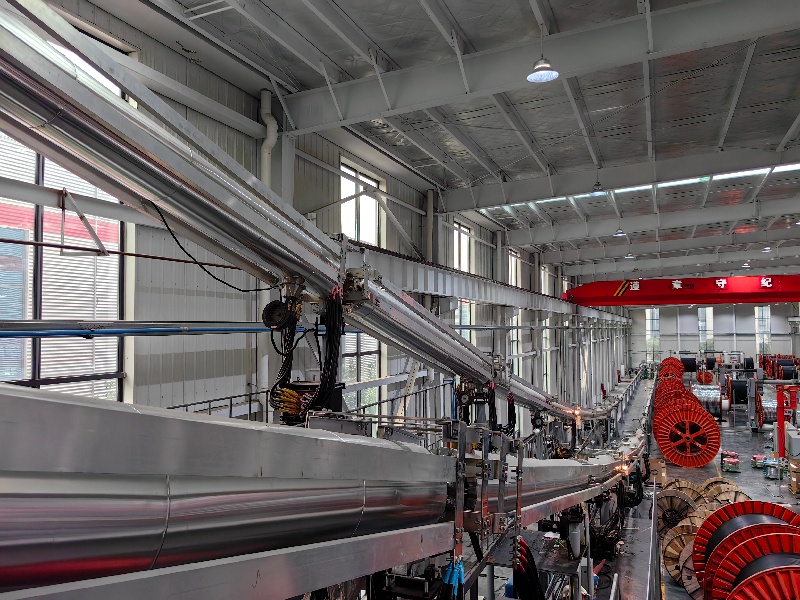
Translating equipment spec sheets into actual production capabilities requires careful analysis. When you evaluate a CCV line used for HT cable, focus strictly on outcomes. Specs mean nothing unless they deliver faster speeds or higher quality. You must link every technical dimension directly to a measurable production advantage.
Heating and curing tube configurations demand your immediate attention. Evaluate the exact heating zone lengths. Check for independent temperature zone controls. Examine the nitrogen circulation efficiency. Longer heating zones deliver faster curing times. They achieve this without degrading the polymer structure through excessive heat. Independent controls allow precise temperature profiling. Nitrogen circulation ensures uniform heat transfer. These dimensions directly impact your maximum line speed.
Cooling zone optimization plays an equally critical role. Evaluate water and gas cooling ratios. Look for robust closed-loop pressure management. Proper cooling prevents micro-voids in thick-wall insulations. It also reduces internal mechanical stress. If cooling happens too rapidly, the XLPE shrinks unevenly. Uneven shrinkage causes dimensional instability. Gas cooling sections before water quenching help temper the cable. This prevents sudden thermal shock.
Process automation and X-ray integration tie the entire system together. Inline X-ray measurement systems scan the cable constantly. They provide real-time wall thickness and concentricity monitoring. This data feeds into the central PLC. The system triggers automated line speed adjustments. It regulates extruder RPM dynamically. This minimizes material scrap entirely. It ensures stringent IEC and IEEE compliance for every meter produced.
Technical Dimension | Equipment Specification | Production Outcome |
|---|---|---|
Heating Configuration | Independent PID temperature zones | Faster line speeds, zero polymer degradation |
Cooling Optimization | Gas/Water ratio controls | Elimination of micro-voids, reduced thermal shock |
Quality Control | Multi-axis inline X-ray scanning | Automated centering, near-zero eccentricity |
Atmosphere Management | Closed-loop nitrogen circulation | Uniform curing, improved dielectric strength |
Facilities rarely run ultra-high-voltage orders year-round. You must maximize Return on Investment (ROI) through production flexibility. Running mixed batches helps maintain maximum Overall Equipment Effectiveness (OEE). High OEE ensures your machinery generates value consistently. Adapting your primary equipment for secondary applications gives you a strong competitive edge.
Medium and low voltage adaptability requires careful assessment. You must evaluate tooling, dies, and cleaning changeover times. Operating the equipment as a Ccv Line for Medium Voltage Projects involves swapping crosshead components. Quick-change mechanisms reduce downtime significantly. Sometimes, market demands force you to run lower tiers. You might utilize it as a CCV line for LV/MV power cables. Evaluate how the master control panel handles recipes for smaller cable diameters. Smaller cables require much lower line tensions and specialized puller adjustments.
Alternative materials demand specific hardware modifications. XLPE dominates the high-voltage sector. However, rubber compounds serve crucial industrial niches. If you want to run CV lines for rubber cables, you must change extrusion parameters. Evaluate the required screw designs. Rubber compounds like EPR (Ethylene Propylene Rubber) need specific L/D ratios. They require distinct shear profiles. Curing temperatures differ drastically. Rubber compounds often cure differently than XLPE. You might need hardware capable of handling alternative vulcanization environments. Some rubber lines use steam instead of dry nitrogen gas. Verify if your curing tube supports dual-mode operation.
Common Mistakes: Do not assume an HV line runs LV cables perfectly out of the box. Small cables often stretch under the high tension designed for heavy HV cables. You must install sensitive tension control dancers for low-voltage batch runs.
Physical facility limits dictate your extrusion strategy. The gravity problem dominates heavy cable manufacturing. You must objectively weigh a Catenary Continuous Vulcanization (CCV) line against a Vertical Continuous Vulcanization (VCV) line. Extra-high voltage cables feature massive conductor cross-sections and extremely thick insulation walls. Heavy melted polymer sags downward under its own weight. This gravity effect causes pear-shaped insulation if left unchecked.
Catenary curve engineering solves this gravity problem mathematically. The specific weight of the uncross-linked cable limits the catenary equation. Vendors calculate tube layout and height requirements meticulously. They design the entry angle to match the natural droop of the hot cable. Proper engineering prevents insulation drooping before cross-linking locks the polymer structure into place. However, there is a physical limit. Once cables exceed certain weight thresholds, CCV lines struggle. VCV lines drop the cable straight down. They eliminate gravity-induced eccentricity entirely.
Implementation risks require proactive management. You face substantial civil engineering challenges.
Foundation Requirements: CCV lines require tall upper floors or specialized tower structures. They need massive concrete foundations to eliminate vibrations near the crosshead.
Structural Footprint: The catenary slope stretches horizontally for roughly 100 to 150 meters. Your factory hall must accommodate this massive linear footprint.
Cooling Water Pits: You must excavate deep trenches for end-seal water collection and circulation pumps.
Commissioning Timelines: Aligning a 150-meter heated tube requires optical laser precision. Rushed alignments cause cable scraping.
Factory Acceptance Testing (FAT): Never skip strict FAT protocols. Test the actual polymer compounds and conductor sizes you plan to use before shipping the equipment.
VCV towers demand massive vertical clearance. They often exceed 100 meters in height. Constructing a VCV tower requires aviation clearance and complex civil engineering. CCV lines offer a compromise. They require only 30 to 50 meters of height. This makes them far more adaptable to standard industrial parks.
Modern cable manufacturing must align tightly with global sustainability goals. Environmental, Social, and Governance (ESG) criteria matter deeply. Your equipment choices directly impact your corporate carbon footprint. You must scrutinize vendor claims regarding heating efficiency closely. Curing tubes consume massive amounts of electrical power. Advanced thermal insulation on the tube exterior prevents heat loss. It keeps the energy focused on the cable.
Nitrogen recovery systems represent a major sustainability upgrade. Older lines vent pressurized nitrogen into the atmosphere. This wastes industrial gases constantly. Modern setups use closed-loop nitrogen management. They filter out byproducts like methane and acetophenone. Then, they recirculate the clean nitrogen gas. Look for verifiable data on kW per kg of processed material. High-efficiency drives and optimized heating profiles lower this ratio significantly. Lower energy consumption supports strict ESG mandates.
Scrap reduction serves as another critical sustainability pillar. Extruding polymers is a resource-intensive process. XLPE compound requires significant energy to produce chemically. Every kilogram of scrapped cable represents wasted embedded carbon. Connect your automated eccentricity controls directly to raw material savings. By utilizing multi-axis X-ray scanners, you eliminate startup scrap. You prevent out-of-spec runs. Saving raw polymer protects natural resources. It makes your entire operation leaner and much greener.
Choosing the correct CCV line requires evaluating triple extrusion crosshead technology for interfacial purity.
You must analyze facility physical constraints, matching catenary curve limitations against your building's height and length.
Inline quality control systems, like X-ray scanners and automated centering, are mandatory for minimizing polymer waste.
Next Step: Request a customized catenary layout simulation from short-listed vendors.
Next Step: Ask vendors to map out processing parameters based on your exact plant cable mix (HV, MV, LV) before issuing an RFQ.
A: The practical threshold typically sits around 220kV to 400kV. This depends heavily on conductor size and insulation thickness. Beyond 400kV, the heavy melted polymer experiences severe gravity-induced sagging. This sagging creates unacceptable eccentricity. VCV drops the cable straight down, eliminating gravitational droop. Therefore, VCV becomes a safer choice for ultra-heavy EHV cables despite higher tower construction demands.
A: A true triple CCV line uses a single-head triple-extrusion process. It extrudes the inner semicon, XLPE insulation, and outer semicon simultaneously. Standard tandem setups extrude these layers sequentially. Simultaneous triple extrusion guarantees absolute interface purity. It prevents atmospheric contamination and ensures a perfectly smooth boundary. This smoothness prevents electrical treeing in high-stress electrical fields.
A: Yes, but it requires specific hardware modifications. You need interchangeable extruders and different screw geometries. XLPE and rubber compounds like EPR have vastly different shear profiles. Additionally, you must tailor the curing tube environments. Rubber often requires steam vulcanization, whereas XLPE requires dry pressurized nitrogen gas. Verify that your line supports dual-mode curing.
A: You must prepare a comprehensive technical dossier. List maximum and minimum cable diameters. Specify conductor materials (copper/aluminum) and cross-sectional sizes. Define your target line speeds and output capacity. Detail the specific polymer types you will process. Finally, provide exact factory dimensions, including available linear length, trench depth, and maximum ceiling height.