

Views: 0 Author: Site Editor Publish Time: 2026-09-01 Origin: Site


Whether it is the fiber-optic network keeping a massive data center online or the high-voltage lines powering a city block, modern infrastructure shares one critical dependency. Everything hinges on the precise manufacturing of conductive materials. At the absolute center of this industrial ecosystem are wire and cable extrusion systems. These sophisticated setups serve as the undisputed backbone of the cable industry, tasked with applying highly durable, perfectly uniform layers of insulating and jacketing polymers over bare metal conductors.
As global demand surges for higher electrical transmission capacity and increasingly stringent safety regulations take effect, grasping the underlying mechanics of these machines is no longer optional. For facility managers, production engineers, and B2B procurement teams, upgrading legacy equipment requires a granular understanding of extrusion technology. Even a microscopic deviation in insulation thickness can trigger catastrophic electrical shorts, severe signal attenuation, or hazardous thermal hotspots on the factory floor.
This comprehensive guide breaks down the exact operational physics of these extrusion systems. By exploring the core mechanical components, the step-by-step production journey, and highly specialized machinery, manufacturing professionals can make objective, data-driven decisions when scaling their production capabilities.
The extrusion process relies on a continuous, highly synchronized application of mechanical shear and thermal energy to melt polymers, coating them concentrically over a moving conductive core.
A standard production line is an integrated ecosystem of components. The primary sections include the tension-controlled pay-off, induction pre-heater, main extruder barrel, crosshead die, gradient cooling trough, capstan, and automated take-up mechanism.
Equipment specifications are strictly dictated by the end product. Machinery engineered for small-gauge residential wires focuses on blistering output speeds, while industrial power cable lines prioritize massive torque and polymer plasticization capacity.
Modern extrusion facilities heavily utilize advanced programmable logic controllers, precision tooling solutions, and automated inline quality control instruments to eliminate material waste and ensure strict compliance with international dimensional tolerances.
Looking at current industry trajectories, the global push toward grid modernization and the rapid expansion of electric vehicle infrastructure are fundamentally reshaping cable manufacturing. Market analysts note an unprecedented spike in demand for high-voltage, temperature-resistant, and environmentally robust cables. Consequently, manufacturers are being forced to adapt their operational parameters.
Today's extrusion lines must be capable of processing advanced, highly viscous Low Smoke Zero Halogen compounds with absolute zero margin for error. Safety standards in renewable energy sectors have become uncompromising. Furthermore, the rise of offshore wind farms demands subsea cables with flawlessly extruded, ultra-thick protective jackets that can withstand decades of corrosive saltwater exposure and immense deep-sea pressure. Precision is no longer just a quality metric. It is a strict, heavily regulated safety mandate that dictates the baseline engineering of modern extrusion equipment.
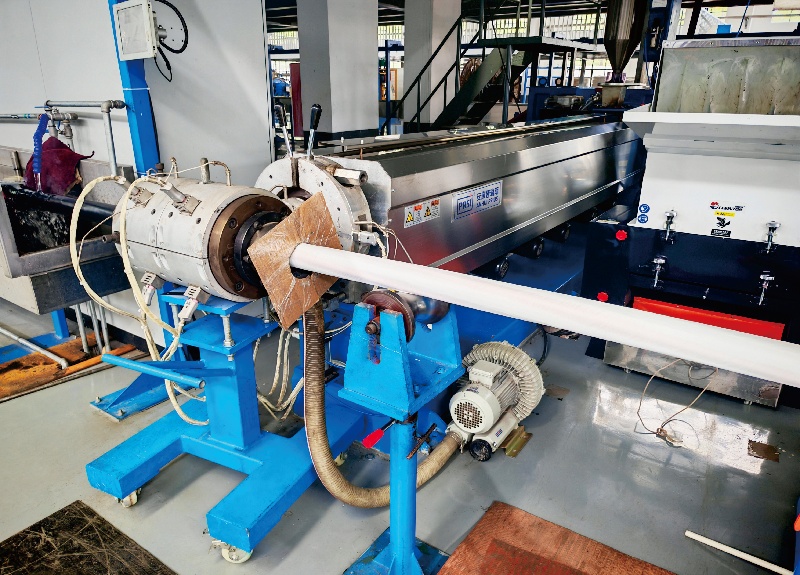
A high-functioning extrusion setup is never just a single piece of machinery. Rather, it is a highly synchronized sequence of specialized components working in perfect harmony. Walk down any active factory line, and you will notice that each distinct section plays a critical role in maintaining the delicate balance of tension, temperature, and material flow.
The manufacturing journey begins at the pay-off unit, which cradles the massive spool of bare copper, aluminum, or fiber optic core. The primary function here is far more complex than simply unspooling wire. It must feed the conductor into the line at a controlled, unwavering rate. Modern units utilize motorized braking systems, pneumatic tension controllers, and dancer arms acting as tension accumulators. If the wire is pulled too aggressively, the copper stretches, altering its electrical resistance. If fed too loosely, it tangles. Consistent input tension prevents these catastrophic line failures.
Before the cold metal conductor enters the extrusion crosshead, it glides through an induction pre-heater. Applying molten plastic that often exceeds 180 degrees Celsius directly to cold copper induces immediate thermal shock. This drastic temperature differential leads to poor polymer adhesion, internal mechanical stress, and microscopic voids within the insulation. Specifically, pre-heating the conductor ensures an optimal, tight bond between the metal and the plastic casing. This factor is exceptionally critical for high-frequency data cables and high-voltage power lines.
Serving as the beating heart of the operation, the extruder consists of a heavy-duty, hardened steel barrel and a rotating Archimedes screw engineered with distinct geometric zones for feeding, compression, and metering. As the screw turns, it conveys the solid resin forward, compressing and melting it through intense shear friction. The length-to-diameter ratio of the screw dictates the machine's overall plasticizing capability. In practice, different polymers demand highly specific screw geometries to prevent thermal degradation while ensuring a perfectly homogenized melt.
The crosshead is the critical mechanical junction where the pressurized molten polymer physically meets the moving conductor. Inside this heavy metal housing, the flow of liquid plastic is redirected, typically at a 90-degree angle, and distributed evenly around the wire via a deflector. The extrusion tooling, comprising a highly polished tip and die, dictates the final outer diameter and wall thickness. Operators rely on micrometric adjustment screws here to guarantee perfect concentricity, ensuring the copper core sits exactly in the dead center of the insulation.
Once the coated wire bursts forth from the die, the plastic jacket is still molten and highly susceptible to physical deformation. It instantly plunges into a long, stainless-steel cooling trough filled with circulating water. This cooling process is multi-staged and meticulously calculated. It typically begins with warm water and gradually transitions to a chilled bath. This gradient cooling strategy prevents the polymer from shrinking too rapidly, which would otherwise induce mechanical stress cracking or vacuum voids within the protective jacket.
The capstan provides the primary pulling force for the entire production line. Whether utilizing a dual-wheel setup for agile small-gauge wires or a massive caterpillar puller for heavy industrial cables, the capstan must maintain an absolutely constant linear speed. Any fluctuation here instantly ruins the cable's dimensional tolerances. Finally, the take-up mechanism receives the finished product, utilizing sophisticated traverse algorithms to wind the cooled cable onto a shipping spool in neat, overlapping rows without crushing the fresh insulation.
Understanding the chronological journey of a single segment of wire clarifies exactly how these complex mechanical components interact in real-time. Because the process is entirely continuous, any sudden interruption typically results in hundreds of meters of scrapped, unusable material.
The operational sequence initiates at the hopper. Hygroscopic thermoplastic pellets, color masterbatches, and chemical additives are vacuum-loaded and dried. Advanced lines feature gravimetric dosing systems that continuously weigh the exact amount of material entering the barrel, matching the resin flow perfectly to the line speed. Inside the heated barrel, the rotating screw and external band heaters work collaboratively to transform the solid mixture into a smooth, stable melt.
While the resin melts, the pay-off releases the bare conductor into the system. The wire navigates a labyrinth of pulleys and dancer arms to establish a baseline tension. It then shoots through the induction pre-heater, where its surface temperature is rapidly elevated to match the processing parameters of the specific polymer waiting in the crosshead.
The pre-heated wire enters the rear of the crosshead, passing precisely through the inner tooling tip. Driven by the immense pressure of the extruder, the molten plastic flows completely over the tip and through the outer die, seamlessly enveloping the moving wire. The exact pulling speed of the capstan, mathematically paired with the RPM of the extruder screw, locks in the final thickness of this coating.
Exiting the crosshead, the newly coated wire often emits a faint trail of steam before plunging into the water cooling trough. For specialized cross-linked materials, the wire might first pass through a high-temperature vulcanization tube to trigger chemical curing before hitting the water. As thermal energy transfers to the water bath, the polymer crystallizes, locking the physical dimensions of the cable into place permanently.
Before the fully solidified wire is spooled, it zips through an inline printing station. Factory-integrated thermal transfer printers or continuous inkjet coders rapidly apply vital data directly onto the cable jacket, including voltage ratings and safety certifications. In the final continuous stage, the cable passes through an array of non-destructive testing instruments. High-voltage spark testers scan for invisible pinholes, while optical laser gauges verify the outer diameter. Once cleared by the automated systems, the capstan feeds the flawless wire to the take-up unit.
Cable manufacturing is inherently diverse. It is not a one-size-fits-all industry. The mechanical torque and speed required to produce a thin residential copper wire differ drastically from the brute force needed to jacket a steel-armored subterranean power cable. Consequently, facilities must deploy specialized machinery tailored to their specific product portfolios.
When outfitting a facility for residential building wires like standard building wiring, investing in a dedicated household wire extrusion line becomes the most logical operational choice. Because the cross-sectional area of these wires is minimal, the primary engineering focus of this machinery is extreme speed and continuous efficiency.
These agile lines typically utilize smaller extruder sizes featuring 50mm to 70mm screw diameters. They are equipped with rapid-dissipation cooling troughs and high-speed dual-flyer take-up systems capable of automatically switching full spools for empty ones without halting the line. Output speeds on these highly specialized setups can easily exceed hundreds of meters per minute, making them incredibly cost-effective for high-volume, low-margin production runs.
In contrast, manufacturing multi-core control cables, data trunk lines, or armored outdoor cables demands a completely different mechanical approach. In these scenarios, a high-performance cable sheathing line is deployed to apply the thick, outer protective jacket over an assembly of inner cores that have already been insulated.
These robust lines are characterized by their superior pulling power, frequently utilizing heavy-duty caterpillar capstans rather than simple wheel pullers to grip the thick cable without crushing the internal components. Furthermore, they often feature advanced co-extrusion capabilities. This allows manufacturers to apply two distinct layers of plastic simultaneously, injecting a soft inner bedding layer while simultaneously extruding a tough, UV-resistant outer jacket.
For large-scale industrial power transmission, massive infrastructure projects, and subsea cabling, the physical demands placed on the machinery scale up exponentially. Equipment designed for this heavy-duty sector must process immense volumes of dense polymer to coat cables that can easily exceed 100mm in overall diameter.
To handle this, operators rely on massive equipment like the 150mm high-efficiency sheathing line. The 150mm designation refers to the massive diameter of the extruder screw, which maximizes plasticizing output. Built to handle annual production capacities reaching tens of thousands of tons, the larger screw size ensures that thick, heavy outer jackets are extruded with perfect thermal homogeneity. This prevents material degradation and maintains the absolute structural integrity required for cables deployed in harsh, subterranean, or underwater environments.
In the highly regulated, safety-critical cable industry, quality simply cannot be inspected into a product after it has been manufactured. It must be guaranteed in real-time during the extrusion process. Modern lines integrate sophisticated, non-destructive testing instruments that monitor the cable continuously as it moves down the line.
Optical measurement systems utilize dual-axis or triple-axis lasers to continuously scan the outer diameter of the cable the moment it exits the cooling trough. These highly sensitive gauges detect microscopic variations in wall thickness. In addition, insulation integrity is a non-negotiable safety factor. Spark testers apply a high-frequency alternating current directly to the moving wire's jacket. If there is a microscopic pinhole or a bare spot in the plastic, the electrical current instantly arcs through the gap to the grounded copper core. The system immediately registers the fault, triggers an alarm, and logs the exact meter location of the defect.
The true operational value of these testing instruments lies in their direct integration with the machine's programmable logic controller. If the laser gauge detects that the cable diameter is trending slightly too thin, the controller automatically initiates a closed feedback loop. It will instantaneously decrease the capstan's pulling speed by a fraction of a percent, or slightly increase the extruder's screw RPM to deposit more plastic. This corrects the dimensional deviation in real-time, entirely without human intervention.
For factory owners, production managers, and procurement engineers, selecting the correct extrusion machinery represents a high-stakes capital investment. The decision must be driven by empirical production data, material requirements, and long-term facility scaling strategies.
The primary calculation involves perfectly matching the machine's plasticizing capacity to your required factory output. Evaluating whether you need a compact, high-speed setup or a heavy-duty high-efficiency extruder sheathing line depends entirely on your target market. If your facility focuses on high-tonnage industrial power cables with thick outer jackets, investing in a machine with a small screw diameter will severely bottleneck your production. Conversely, using an oversized extruder for thin household wires leads to polymer degradation, as the plastic spends too much residence time baking inside the massive barrel.
Beyond capacity, buyers must scrutinize material compatibility. Not all industrial plastics melt the same way. Polyvinyl chloride is notoriously heat-sensitive and requires a low-shear screw profile to prevent burning. Cross-linked polyethylene and halogen-free compounds possess much higher viscosities and require distinct compression ratios. Procurement teams must ensure the manufacturer offers customized screw and barrel geometries specifically engineered for the exact polymers they intend to process.
Even the most advanced extrusion equipment requires rigorous, scheduled maintenance to prevent catastrophic downtime. Routine maintenance protocols should include daily cleaning of the crosshead tooling, regular inspections of the extruder screw for abrasive wear, and the precise calibration of electrical heating zones to ensure thermal accuracy.
When issues do arise, operators must diagnose them swiftly. For example, if the finished cable presents a rough, matte, or shark-skin surface, it often indicates improper melting. The solution typically involves adjusting the barrel temperature zones or verifying that the raw plastic resin was properly dried, as trapped moisture causes surface bubbling. Alternatively, if the laser gauge reports a constantly fluctuating cable diameter, maintenance teams should immediately inspect the capstan for inconsistent pulling tension or check the extruder drive motor for RPM instability.
Wire and cable extrusion lines are incredibly complex, highly synchronized manufacturing ecosystems. Precision tooling, thermodynamic control, and mechanical speed dictate the ultimate safety and quality of the final product. From the initial melting of the polymer resin to the final automated spooling of the cooled cable, every single component must operate flawlessly to meet stringent global electrical standards.
As the demands of modern infrastructure continue to evolve, choosing the right specific setup is the most critical strategic decision a cable manufacturer will make. Whether your facility requires the blistering speed of a dedicated household wire line or the massive plasticizing torque of a heavy-duty sheathing line to tackle industrial power grids, aligning your machinery with your production goals ensures minimized waste and a maximized return on your capital investment. For manufacturers ready to scale their operations with precision-engineered equipment, exploring customized extrusion solutions at Anhui SJ provides the technical foundation needed to dominate today's competitive cable market.
These versatile machines can process a wide variety of thermoplastic and thermosetting polymers. The most common materials include Polyvinyl Chloride, Polyethylene, Cross-linked Polyethylene, Polyurethane, Nylon, Teflon, and Low Smoke Zero Halogen compounds. It is important to note that different materials often require specific extruder screw designs to melt properly without degrading.
An insulation line is specifically designed to apply the very first layer of plastic directly over a bare metal conductor like copper or aluminum. In contrast, a sheathing line is used later in the manufacturing process to apply the final, thick outer protective layer over an assembly of one or multiple inner cores that have already been insulated.
A manufacturer should consider upgrading to a 150mm system when their production shifts toward large-diameter industrial power cables, armored cables, or subsea lines. These applications require the application of very thick outer jackets. The large 150mm screw provides the massive plasticizing capacity necessary to extrude large volumes of polymer stably and efficiently in a single pass.
Because household building wires have very small cross-sectional areas and thin insulation walls, the equipment is optimized for extreme speed rather than heavy torque. These highly specialized lines routinely operate at speeds ranging from 300 to over 800 meters per minute, depending on the specific wire gauge and the efficiency of the water cooling trough.
Thickness and dimensional accuracy are maintained through a combination of precision-machined crosshead tooling, absolutely constant pulling speed from the capstan, and steady polymer output from the extruder. Modern lines also utilize inline laser diameter gauges that continuously measure the wire and send real-time feedback to the machine's programmable logic controller, automatically adjusting speeds to correct any minor deviations instantly.