

Views: 0 Author: Site Editor Publish Time: 2026-07-08 Origin: Site


Upgrading or installing a new continuous vulcanization system demands careful planning. Plant managers and technical directors must balance high initial capital expenditures against long-term yield improvements. Rubber compounds present unique cross-linking challenges. They behave differently than standard XLPE. This material difference requires a highly controlled curing environment to prevent structural defects. Heavy rubber-sheathed cables face constant gravity-induced deformation during production. Without precise tension and temperature control, manufacturing runs suffer from unacceptable scrap rates.
This article provides an objective, engineering-focused evaluation framework. You will discover the critical parameters for selecting a CCV line. We outline necessary process controls, quality control standards, and implementation realities. By understanding these mechanical factors, you can scale your rubber extrusion operations successfully while meeting stringent international compliance standards.
Deploying a purpose-built CCV line for LV/MV power cables maximizes output consistency and minimizes gravity-induced insulation deformation in rubber compounds.
Optimizing curing tube temperature, line speed, and nitrogen pressure is non-negotiable to prevent porosity and ensure proper vulcanization.
Integrating inline X-ray eccentricity measurement and automated sag control directly correlates to lower scrap rates and compliance with IEC quality standards.
When evaluating a Triple CCV Line for High Voltage Cable (up to 132kV), buyers must prioritize triple-layer co-extrusion capabilities over standard setups.
Legacy lines often struggle to deliver uniform curing. Heavy rubber-sheathed cables require sustained, evenly distributed heat. When old equipment fails to provide this consistency, you face high scrap rates. Insulation thickness becomes dangerously unpredictable. This physical inconsistency directly impacts your bottom line. Manufacturers simply cannot afford these yield bottlenecks in today's competitive market.
Shifting production upward brings new engineering hurdles. Transitioning from low voltage output to a Ccv Line for Medium Voltage Projects requires stricter environmental controls. You must prevent micro-voids inside the insulation layer. Even tiny air pockets compromise the electrical integrity of medium voltage cables. A modern extrusion upgrade eliminates these risks. It stabilizes the cross-linking environment entirely.
Sustainability mandates also drive modern facility upgrades. Current CV lines for rubber cables incorporate advanced conservation features. They use closed-loop nitrogen cooling systems. They optimize heating zones to prevent energy waste. These mechanical innovations directly reduce energy consumption per meter of cable. Responsible facility operation now requires this level of efficiency. Meeting corporate ESG targets demands replacing inefficient legacy systems.
Structuring the line correctly forms your manufacturing foundation. Triple co-extrusion heads remain absolutely essential for high-tier production. They ensure seamless bonding in a single, continuous pass. You must bond the conductor screen, rubber insulation, and insulation screen together simultaneously. Doing this prevents contamination between critical layers. It forms a unified, robust dielectric barrier.
The catenary tube design solves major physical challenges. Gravity constantly pulls on hot, semi-liquid rubber insulation. If left unsupported, the material sags downward. The engineered catenary curve mimics the natural droop of heavy cable. This mathematical design mitigates gravitational pull before cross-linking completes. It keeps the heavy conductor perfectly centered.
Heating and cooling zones require careful transition mechanics. Vulcanization usually starts under high-pressure steam or radiant heat. Afterward, the line transitions abruptly to pressurized water or nitrogen cooling. This shift halts the curing process exactly when needed. Precise zone transitions prevent thermal degradation.
Rubber compounds vary significantly across different batches. EPR and EPDM behave differently under intense heat. Your line configuration must offer modular heating zone controls. Modular zones accommodate specific compound curing curves easily. A Triple CCV Line for High Voltage Cable excels in this exact scenario. It allows independent temperature adjustments across multiple isolated zones.
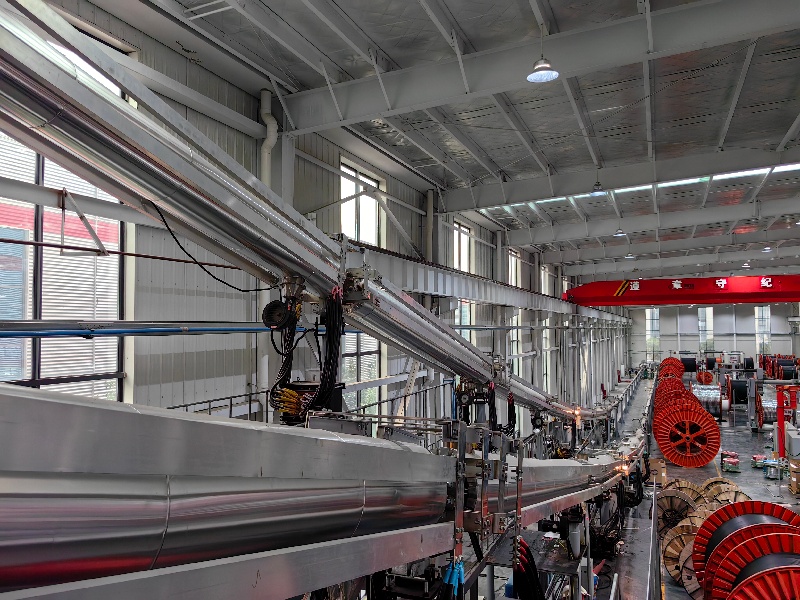
Managing process parameters separates acceptable cables from expensive scrap. Temperature profiling remains your most critical operational task. You must manage the exact temperature gradient across the entire vulcanization tube. Too much heat causes irreversible surface scorching. Too little heat fails to achieve deep, structural cross-linking. Operators must calibrate these thermal zones continuously.
Line speed directly dictates material curing time. You must calculate the exact residence time required in the primary heating zone. Pushing line speeds too high causes severe structural issues. Over-speeding remains the leading cause of under-cured, structurally weak rubber cables. You must balance aggressive output goals against physical curing requirements.
Pressure management prevents internal structural flaws. Maintaining optimal nitrogen or water pressure in the curing tube is vital. This ambient pressure suppresses gas expansion within the hot rubber compound. Suppressing gas expansion eliminates dangerous porosity. Micro-voids simply cannot form under proper atmospheric pressure.
Parameter Type | Operational Target | Primary Purpose | Common Mistake to Avoid |
|---|---|---|---|
Heating Zone Temps | Gradual increase (180°C - 220°C) | Initiate deep cross-linking | Applying maximum heat too early |
Cooling Zone Pressure | Matched to compound specs (e.g., 10-15 bar) | Suppress void formation | Dropping pressure before material solidifies |
Line Speed | Calculated via residence time formula | Ensure full vulcanization | Accelerating speed to meet daily quotas |
Continuous inline inspection guarantees final product viability. You need advanced X-ray eccentricity and wall thickness measurement tools. Continuous, 360-degree inline monitoring represents the modern industry standard. It ensures the conductor remains perfectly centered within the rubber insulation. Catching eccentricity early prevents kilometers of unusable scrap.
Sag control automation protects the physical cable continuously. Utilizing electromagnetic or optical sensors represents standard best practice. These sensors monitor the cable's exact spatial position inside the catenary tube. The automated system adjusts line tension based on instant sensor feedback. This reaction prevents the heavy cable from scraping against internal tube walls.
Cross-linking degree testing verifies structural integrity post-production. The hot set test defines these rigid laboratory standards. You must verify that the CCV line used for HT cable meets structural mandates. Cables must survive intense thermal stress without deforming. Meeting strict IEC quality standards requires passing these laboratory tests consistently.
Follow these essential inline inspection steps during active runs:
Calibrate X-ray measurement sensors before compound introduction.
Monitor the tension control dashboard for micro-fluctuations.
Verify nitrogen purity levels in the cooling zone hourly.
Extract physical samples post-cooling for immediate hot set testing.
Choosing between CCV and VCV lines requires deep facility analysis. Footprint and architectural requirements differ drastically between the two. A CCV layout requires significant horizontal plant length. However, it fits comfortably within standard industrial ceiling heights. A VCV layout requires constructing a massive, costly vertical tower. The vertical design eliminates all gravity sag issues entirely.
Voltage application ceilings dictate your ultimate technology choice. A CCV line for LV/MV power cables is highly optimal and cost-effective up to 132kV. VCV lines become strictly mandatory for ultra-high voltage applications (EHV >220kV). In EHV applications, even microscopic eccentricity proves catastrophic to the grid.
Cost-to-performance ratios heavily favor catenary designs for standard plants. For rubber cables and standard MV/HV applications, CCV offers a faster ROI. It presents significantly lower installation friction than building a VCV tower. You gain exceptional product quality without constructing new, towering building extensions.
Feature | CCV (Catenary Continuous Vulcanization) | VCV (Vertical Continuous Vulcanization) |
|---|---|---|
Gravity Sag Impact | Mitigated via mathematically curved tube | Eliminated entirely (vertical drop) |
Facility Requirement | Long horizontal floor space (100m+) | High vertical tower construction (100m+) |
Optimal Voltage Range | LV, MV, HV (Up to 132kV) | EHV (220kV and above) |
CapEx & Installation | Moderate initial investment, faster setup | Extremely high investment, complex civil works |
Installing heavy extrusion machinery carries distinct implementation risks. You must factor in four to six weeks for initial commissioning. Extensive calibration happens during this critical startup period. Aligning the extrusion head exactly with the catenary tube requires precision optical leveling. A single millimeter of misalignment causes severe scraping issues later.
Evaluate equipment vendors on specific, technical criteria rather than just price. Do they offer full turnkey installation or merely equipment delivery? Turnkey partners reduce your commissioning risks significantly. Can they demonstrate precise tension control algorithms in action? These algorithms must be specifically coded for heavy rubber compounds. Generic XLPE algorithms will fail when handling elastic rubber.
Check the availability of localized spare parts rigorously. High-wear extrusion screws and tube seals need regular replacement schedules. Waiting months for imported proprietary parts stalls your entire facility. Ensure your vendor stocks wear parts regionally.
Your final evaluation step involves active material testing. Request material test runs from shortlisted OEMs. Use your facility's specific rubber compounds for these tests. Do this before signing any binding purchase orders. Real-world material testing exposes mechanical machine limitations early.
A properly calibrated catenary system remains the most reliable pathway for scaling rubber cable production. It serves MV and HV markets without compromising structural integrity. By carefully managing temperature profiles, line speed, and tube pressure, operators can virtually eliminate porosity and eccentricity defects. Always prioritize advanced inline quality control sensors during the procurement phase.
Base your final vendor selection on modularity and tension control sophistication rather than maximum advertised line speed. Focus your facility upgrades on equipment offering proven triple co-extrusion capabilities. Finally, insist on running your exact rubber compounds through the OEM’s test lines prior to committing capital. This ensures a seamless transition into higher voltage manufacturing tiers.
A: While optimal for LV and MV, a highly calibrated Triple CCV line can successfully manufacture cables up to 132kV. Exceeding this limit typically requires vertical configurations to prevent minute gravity sagging.
A: Pressurized nitrogen prevents oxidation at high temperatures and suppresses the formation of micro-voids (porosity) inside the rubber compound during the curing phase. This ensures dense, reliable insulation.
A: A CCV uses a mathematically calculated catenary curve tube to support the weight of heavy cables during the liquid/semi-solid phase, preventing the insulation sagging that occurs in flat horizontal lines.