

Views: 0 Author: Site Editor Publish Time: 2026-07-17 Origin: Site


Upgrading or procuring a Catenary Continuous Vulcanization line stands as a major capital expenditure. This crucial decision directly dictates your facility’s production capacity, overall scrap rates, and final insulation quality. For manufacturers shifting from low-voltage to medium or high-voltage markets, standard extrusion technology simply falls short. You need a properly configured system to meticulously control XLPE or EPR cross-linking. Doing so mitigates gravity-induced insulation sag during the curing process. Without exact tension and thermal control, heavy cable insulation will droop. This causes immediate compliance failures and wastes expensive materials. This guide bypasses basic, surface-level definitions. Instead, we break down the core components, evaluation frameworks, and actual implementation realities. You will discover exactly how to evaluate vendor specifications. Ultimately, you will learn how to confidently shortlist a reliable CCV line for LV/MV power cables to guarantee long-term manufacturing success.
Component Synergy: A high-performing CCV line relies on the seamless integration of triple extrusion, X-ray concentricity control, and precise nitrogen/heating management within the curing tube.
Yield over Speed: Maximum line speed is secondary to continuous concentricity stability; minor droop during the vulcanization phase exponentially increases scrap costs in MV/HV production.
Facility Constraints: Procurement must be evaluated alongside civil engineering realities, as the catenary curve requires specific factory heights and foundational footprints.
Material Flexibility: Modern lines must account for varying curing profiles, transitioning efficiently between standard XLPE and specific configurations like CV lines for rubber cables.
You must clearly define success before initiating procurement. Achieving void-free, perfectly concentric insulation layers remains the core business problem. Premature cross-linking, known as scorching, inside the extruder head ruins entire batches. A well-designed Ccv Line for Medium Voltage Projects solves this directly by managing melt temperatures precisely.
Next, look closely at yield optimization. You must assess the vendor's guaranteed scrap rate. This metric matters most during line start-up and ramp-down phases. Transition lengths often become unsellable scrap. For example, when ramping up an extrusion line, temperature lags create thermal inconsistencies. If the inner semi-con cures faster than the main insulation layer, internal stress tears the material apart. You must monitor these critical variables relentlessly.
Quality assurance standards are non-negotiable in cable manufacturing. Ensure the equipment consistently meets IEC 60502 requirements for medium voltage. If scaling operations upward, it must meet IEC 60840 standards for high voltage. These international standards dictate strict manufacturing tolerances for partial discharge and insulation thickness.
Finally, evaluate Overall Equipment Effectiveness (OEE). Compare your anticipated machine uptime against mandatory cleaning cycles. The crosshead and cooling zones require regular maintenance. Frequent cleaning hurts your daily output. Consider the following best practices during evaluation:
Request documented scrap rates specifically for the first 30 minutes of startup.
Verify temperature uniformity across all extruder barrel heating zones.
Calculate actual production hours after subtracting mandatory crosshead cleaning shifts.
Operational Phase | Key Performance Indicator | Acceptable Benchmark |
|---|---|---|
Line Startup | Scrap generation length | Minimal defined transition meters |
Steady State | Concentricity variance | Under 2% deviation |
Maintenance | Crosshead cleaning downtime | Optimized via rapid-clamp designs |
You cannot evaluate a production line without understanding its individual modules. Each component plays a vital role in dictating final cable geometry. Below, we outline the primary evaluation lenses for major line components.
Pay-off and Accumulator Systems: Tension control precision serves as your main evaluation dimension. You must prevent conductor elongation before the bare wire enters the crosshead. Poor tension creates irregular resistance in the finished cable. Accumulators provide a mechanical buffer. They allow operators to change pay-off reels without halting the entire line. If the line stops unexpectedly, stationary cable inside the curing tube will scorch instantly.
The Extrusion Group (Triple Extrusion): The technical requirement involves simultaneous material application. The system applies the inner semi-con, main insulation, with the outer semi-con simultaneously. Look for optimized flow geometries. They minimize material residence time significantly. When assessing a Triple CCV Line for High Voltage Cable, crosshead thermal isolation remains a strict pass/fail criterion. Heat bleed between composite layers causes severe scorch defects.
The Catenary Curing and Cooling Tube: Modern production demands multi-zone dry curing and water cooling zones. Pressurized high-purity nitrogen drives the curing process. Buyers must rigorously evaluate the tube sag profile matching capability. Check the reliability of the Sag Position Sensor. Often electromagnetic or optical, this sensor prevents heavy hot cable from touching the internal tube walls. Contact causes instant deformation and product failure.
X-Ray Measurement and Closed-Loop Control: Real-time monitoring of wall thickness and concentricity is mandatory. Legacy systems forced operators to guess wall thickness based on manual micrometer checks after the cable cooled. Modern closed-loop X-ray systems scan the hot cable dynamically. Ensure the software offers strong data integration capabilities. It should connect seamlessly to plant ERP systems. The control interface must automatically adjust extruder RPM and line speed based on X-ray feedback. This removes dangerous operator guesswork entirely.
Different insulation materials demand completely divergent thermal approaches. XLPE processing focuses heavily on tight temperature gradients. Operators need exact nitrogen pressure to prevent microscopic voids in cross-linked polyethylene. Uncontrolled moisture introduces permanent electrical weaknesses, making dry nitrogen curing entirely essential for medium voltage cables.
Adapting equipment for rubber compounds introduces complex new manufacturing constraints. Ethylene Propylene Rubber (EPR) and other thermoset rubbers require distinct material handling. They need differently pitched screw designs and specific curing temperature profiles compared to standard XLPE. Rubber compounds tend to cure faster at lower initial temperatures, increasing the risk of early cross-linking inside the barrel.
Assess the equipment vendor carefully regarding material flexibility. Ask if the proposed line requires entirely swap-out crossheads to run rubber. Alternatively, can operators manage the changeover via modular tooling components? Fast changeovers significantly boost your plant's operational responsiveness.
We summarize these fundamental material differences in the following comparison chart.
Processing Parameter | XLPE Requirements | EPR / Rubber Requirements |
|---|---|---|
Curing Medium | High-pressure dry nitrogen environment | Nitrogen or specific atmospheric blends |
Screw Design | High shear, optimized for thorough melting | Low shear, prevents early cross-linking |
Temperature Profile | Gradual heating to peak curing temp | Steeper initial gradient, specific hold times |
Tooling Strategy | Standard flow distribution manifolds | Requires specialized modular flow tooling |
When you invest in CV lines for rubber cables, tooling modularity becomes your biggest defense against excessive maintenance downtime.
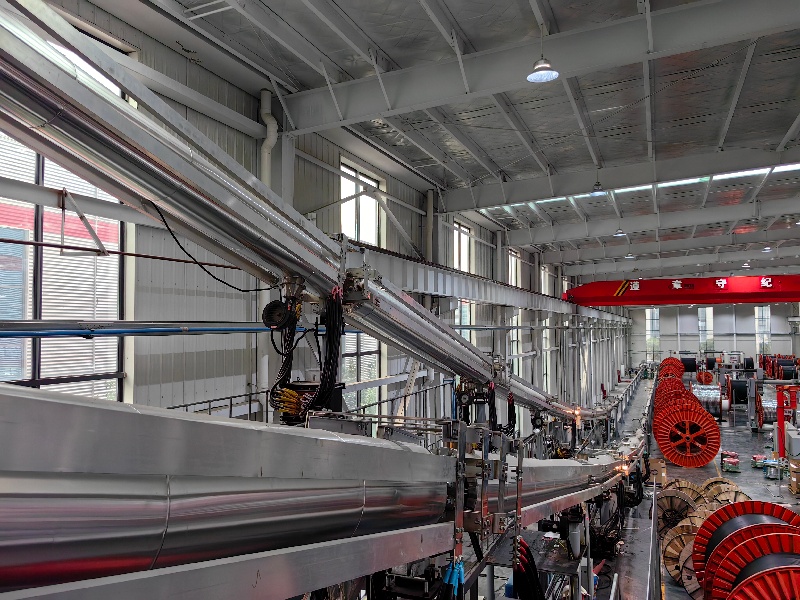
Installing heavy extrusion machinery requires serious logistical pre-planning. Civil engineering dependencies often catch inexperienced buyers completely off guard. A standard continuous vulcanization line requires significant vertical elevation to function correctly. You often need to construct a robust multi-story extrusion tower. This extra height helps achieve the proper catenary angle, usually falling securely between 10 to 20 degrees. Without this precise slope, gravity distorts the hot, semi-liquid insulation before it cures.
Beyond simple vertical height, civil engineers must evaluate floor load capacities. The main extrusion tower houses incredibly heavy machinery, including drive motors, material hoppers, and the massive crosshead assembly itself. Inadequate foundational support leads to unseen micro-vibrations. These vibrations transfer directly to the crosshead, causing severe concentricity deviations in your finished electrical cable.
Factor in extended installation lead times when planning production schedules. You should anticipate a 6-to-12 month operational window. This lengthy period covers equipment delivery, physical assembly, precise laser alignment, and final electrical commissioning. Do not rush the laser alignment phase. Misaligned tubes scrape cables constantly.
Next, deeply consider operator expertise. The heavy reliance on modern closed-loop automation does not negate human skill requirements. You still need highly trained technicians. High-turnover manufacturing facilities face severe financial risks during the transition to automated controls. A single misjudged thermal parameter ruins expensive kilometers of raw material.
Maintenance realities directly dictate your operational return on investment. Assess the physical accessibility of the splice box and main extruder screws. Routine daily maintenance should not require dangerous acrobatics from your team. If standard cleaning takes too long, your daily throughput capacity suffers immensely.
Market demands rarely stay static. You might eventually want to scale production operations upwards into higher voltage tiers. However, manufacturers face a major scalability challenge here. A production line utilized strictly for medium voltage cannot automatically process high or extra-high voltage products. It will require extensive structural and thermal upgrades.
Upgrading an existing setup later causes massive, unpredictable production delays. Therefore, plant engineering teams must project their market footprint five to ten years ahead. Modifying a CCV line used for HT cable involves monumental changes. Higher voltages like 66kV, 132kV, or even up to 220kV require significantly thicker insulation walls. Thicker walls demand substantially longer curing tubes to complete the deep cross-linking process. The cable simply needs more time exposed to high heat.
Furthermore, producing high-tension cables requires ultra-clean material handling systems. Facilities often build sealed class 10,000 cleanrooms strictly for hopper loading. Microscopic contamination at these elevated voltages causes catastrophic electrical failures in underground field trenches.
You must make a critical facility decision early. Determine if your current capital expenditure budget allows for modular tube extensions in the future. If not, a dedicated Vertical Continuous Vulcanization (VCV) line will eventually become necessary for extra-high voltage applications. VCV lines hang the cable completely vertically downward, eliminating gravity droop entirely. However, VCV towers often exceed 100 meters in total height, representing a staggering civil engineering cost. This extreme expense makes modular catenary lines highly attractive for upper-medium and lower-high voltage production tiers.
Base your final vendor selection on long-term performance stability, not purely on the cheapest equipment sticker price. Prioritize demonstrated concentricity stability under continuous load. Evaluate internal crosshead design efficiency and demand robust, localized post-installation technical support from the manufacturer.
For your immediate next steps, request a detailed architectural layout drawing based on your exact factory dimensions. Mandate a trial run data sheet using your specific cable geometries before signing contracts. Finally, calculate your expected raw material yield improvements and daily energy consumption over a 10-year operational horizon. Thorough preparation ensures your upgraded facility remains competitive and highly profitable.
A: Height requirements depend heavily on the specific catenary angle and the target cable weight. However, an extrusion platform typically sits between 12 to 25 meters high. You must construct a dedicated tower. Vendors must provide exact civil blueprints prior to final procurement to ensure your building structure complies.
A: Yes, a well-configured system can handle both voltage levels. However, running simple low-voltage cables on a highly complex medium-voltage line is rarely cost-effective. The machinery consumes significantly higher energy. Standard LV is usually relegated to simpler, faster horizontal extrusion lines.
A: Modern continuous vulcanization almost exclusively uses dry curing via pressurized nitrogen. Steam curing introduces inherent moisture into the curing environment. This moisture causes harmful micro-voids within XLPE insulation. These microscopic defects severely compromise the electrical integrity of medium and high-voltage cables.
A: It takes considerable time for the extruders, crosshead, and curing tube to reach thermal equilibrium. Until machinery stabilizes at the precise target speed and temperature, cross-linking remains incomplete or uneven. This yields unsellable transition lengths. Advanced automation and predictive controls significantly reduce this expensive startup footprint.