
Views: 0 Author: Site Editor Publish Time: 2026-07-21 Origin: Site


Extrusion line speed relies heavily on your downstream pulling equipment. The haul-off unit often acts as the primary bottleneck for both production velocity and final product quality. It dictates how fast you can run your extruder while maintaining tight dimensional tolerances. Inconsistent pulling directly causes severe diameter variations. It leads to unwanted cable deformation and generates expensive material scrap.
Upgrading a legacy extrusion line presents a complex engineering dilemma. Specifying a brand-new line requires making a similarly critical choice. You must choose between traditional mechanical tensioning and modern air-driven systems. Making the wrong choice leads to endless troubleshooting on the factory floor. It forces operators to constantly tweak settings to save the product.
We will break down these two competing technologies. Our objective, engineering-focused approach helps you navigate this decision. You will learn how to match the right traction equipment to your specific cable profiles. We also explore daily operational constraints to guide procurement and production engineers effectively.
Belt type caterpillar units offer robust, high-friction pulling for heavy-duty and standard cables but rely on manual mechanical adjustments that can risk crushing delicate jackets.
Pneumatic caterpillar systems provide dynamic, self-adjusting tension control, making them mandatory for thin-wall, fiber optic, or highly compressible cables.
Correct sizing requires mapping the machine's traction force and contact length against the maximum required line speed and cable outer diameter (OD).
Extrusion success demands absolute precision from downstream equipment. A haul-off machine must meet three strict success criteria. It must deliver zero-slip traction across the entire product length. It needs to maintain a perfectly constant linear velocity. It must also apply minimal surface pressure to the delicate cable jacket. Failing any of these criteria ruins the final product.
The cost of failure remains high in continuous extrusion processes. Micro-slippage causes immediate extruder surging. The plastic flow remains constant, but the pulling speed drops momentarily. This directly leads to inconsistent insulation thickness and lumps. Conversely, over-compression causes severe jacket whitening. It can crush internal metallic shielding. It might even alter the critical impedance values of coaxial cables.
Engineers consistently trust the caterpillar over traditional capstans for primary extrusion lines. Capstans force the cable to bend around a rigid rotating drum. This introduces severe mechanical stress and bending moments. Caterpillars pull the cable in a perfectly straight line. They distribute gripping force over a long, flat contact area. This straight-line, stress-free pulling sets the baseline for quality evaluation. It ensures compliance with the strictest dimensional tolerances in modern wire manufacturing.
Mechanical haul-offs rely entirely on physical hardware for tensioning. They utilize heavy-duty screw jacks or robust spring mechanisms. These components control the distance and force between the upper and lower belts. The operator manually dials in the gap. They set the gripping pressure using large manual handwheels. The system holds this static position throughout the production run.
These units excel in highly demanding, rugged environments. They handle heavy power cables and armored cables effortlessly. They also work perfectly for thick-jacketed industrial wires. In these heavy-duty applications, high continuous traction force matters most. Micro-tension control and delicate handling remain less critical for such rigid products.
Lower Initial Capital Expenditure: Mechanical designs utilize simpler components, reducing upfront procurement costs significantly.
Mechanical Simplicity: Maintenance teams can troubleshoot these machines easily using standard tools. They do not require specialized pneumatic technicians for basic repairs.
Utility Independence: These units operate completely independently. They do not rely on external factory utilities like clean compressed air systems.
No Automatic Compensation: Mechanical units cannot adjust automatically. If the cable outer diameter (OD) varies slightly, the belts cannot absorb the change.
High Risk of Operator Error: Operators must rely on "feel" to set the tension. Over-tightening the handwheels easily leads to permanent cable deformation.
Maintenance Wear: Physical screw threads and springs degrade over time. This introduces backlash, making precise tensioning difficult as the machine ages.
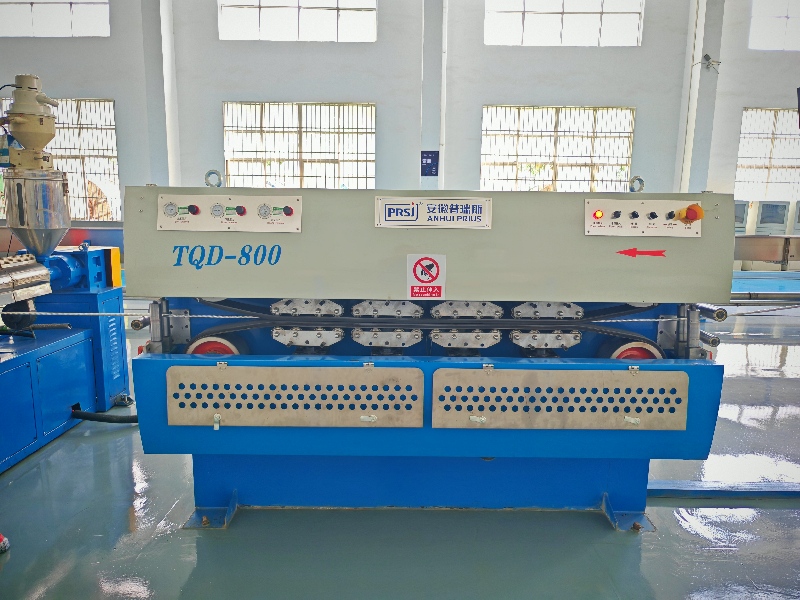
Modern high-speed lines demand automated finesse. A Pneumatic caterpillar uses precision air cylinders to regulate tension. These cylinders apply highly regulated, consistent pressure to the traction belts. The machines include advanced pressure regulators and proportional valves. They feature dynamic gap adjustment capabilities controlled by localized pressure sensors.
They fit perfectly in delicate, high-precision applications. We highly recommend them for fiber optics and sensitive coaxial cables. They handle medical tubing and Category 6 LAN cables beautifully. Any application featuring thin-wall insulation requires this specific technology. Highly compressible cable constructions demand air-driven, responsive finesses.
Dynamic Tensioning: Air acts as a compressible fluid. The air cylinders function as shock absorbers. They maintain even pressure if a cable splice or slight bulge passes through the belts.
Exceptional Repeatability: Operators set exact PSI or Bar metrics on a digital gauge. They no longer rely on the inconsistent physical "feel" of a mechanical handwheel.
Faster Changeovers: Switching between different cable diameters takes seconds. Operators simply adjust the air pressure regulator for multi-product extrusion lines.
Strict Utility Requirements: This system demands a highly stable, clean, and dry factory compressed air supply.
Vulnerability to Moisture: Water or oil in the air lines will rapidly destroy sensitive pneumatic seals and valves.
Higher Complexity: They present a higher initial procurement cost. They also require slightly more complex, specialized maintenance protocols for the pneumatic logic circuits.
Comparing these systems requires looking at your specific factory variables. You must map traction force against product fragility. Mechanical units offer sheer brute force for large cables. They grip hard and pull heavy, inflexible loads without slipping. Pneumatic systems provide a finessed, evenly distributed load. They actively prevent crushing on fragile, hollow, or thin-walled products.
Changeover times differ significantly between the two architectures. A belt type caterpillar requires slow manual calibration. Operators spend valuable minutes adjusting dual handwheels. They must carefully verify the gap with calipers or gauges. Pneumatic units use digital or gauge-driven resets. You simply adjust a dial to a documented pressure setting. This drastically speeds up changeovers on lines running multiple daily SKUs.
Integration capabilities also impact your floor layout and automation strategy. Modern haul-offs must tie into your central Programmable Logic Controller (PLC). They need to synchronize seamlessly with the main extrusion line. They rely on dancer arm or accumulator feedback loops. Pneumatic setups integrate beautifully with automated tension adjustments via electro-pneumatic transducers. Mechanical units usually remain stubbornly isolated as standalone machines.
Maintenance routines involve completely different skill sets. Mechanical units need standard greasing and wear part replacements. You must regularly lubricate the threaded rods and replace grabber belts. Pneumatic variants require servicing specialized air cylinders. You must maintain directional control valves and check delicate O-ring seals. Both formats share the need for routine belt material swaps.
Feature Category | Mechanical Belt Type | Pneumatic Type |
|---|---|---|
Tension Control Method | Manual screw jacks or springs | Regulated air cylinders |
Dynamic Adjustability | None (Static gap position) | High (Acts as a shock absorber) |
Ideal Cable Construction | Armored, heavy power, thick jacket | Fiber optic, LAN, medical, coaxial |
Operator Skill Required | High (Relies on operator "feel") | Low (Follows documented PSI settings) |
Risk of Cable Crushing | High (If over-tightened) | Very Low (Pressure limits are capped) |
Utility Dependency | Electrical power only | Electrical + Clean compressed air |
Dropping new equipment onto an old floor rarely happens without friction. Real-world implementation requires careful planning to avoid production downtime. We compiled vital adoption lessons directly from factory floors to guide your integration.
Retrofitting Challenges: Dropping a new caterpillar into a 15-year-old extrusion line presents severe hurdles. Electronic synchronization often becomes the primary point of failure. You must ensure the new unit's drive communicates perfectly with legacy extruders and take-ups. Mismatched drive speeds will instantly stretch or snap the hot cable.
The "Dirty Air" Problem: Factory air systems notoriously ruin new equipment. A common failure mode for pneumatic units is contaminated factory air. Oil blow-by and condensation severely damage internal components. You must highlight the absolute necessity of installing inline desiccant air dryers and micron filters directly at the machine inlet.
Belt Selection Matters: The machine's technology means nothing without the right contact material. Selecting the wrong belt material negates the benefits of the machine. Polyurethane offers exceptional wear resistance for abrasive jackets. Natural rubber provides better high-friction grip for smooth plastics. Profiled belts cradle round cables perfectly. Flat belts suit flat wiring or highly variable sizes.
Safety and Compliance: Moving belts create extremely dangerous pinch points for operators. You must adhere to local safety regulations immediately. CE and OSHA guarding requirements dictate strict physical barriers. Ensure your new machine includes electronic safety interlocks. Opening the guard doors must instantly halt the pulling mechanism.
Best Practice: Always document specific machine settings for every cable SKU. Create a visual chart on the machine detailing the exact air pressure or handwheel turns required. This removes operator guesswork.
Common Mistake: Ignoring belt wear limits causes immense scrap. Operators often increase clamping pressure to compensate for worn, smooth belts. This crushes the cable instead of fixing the underlying traction issue. Replace belts when the durometer changes or the surface glazes over.
Approaching a vendor without hard data leads to under-sized or over-priced machinery. Proper specification requires a detailed understanding of your production limits. Start by compiling exact operational data.
Data gathering forms the foundation of your equipment search. You must compile your absolute minimum and maximum cable OD. Document your maximum required line speed in meters per minute. Calculate your maximum required traction force based on your heaviest reel and take-up tension. Provide this comprehensive data package before contacting any equipment vendors.
Vendor vetting separates premium manufacturers from unreliable suppliers. Always advise your procurement team to ask manufacturers for trial runs. Request detailed case studies matching your specific cable construction. Ask them to prove their machine's linear speed accuracy with real-world charts. Verify their local support network for replacement belts and spare parts.
Action drives results. We encourage you to consult closely with your internal engineering team today. Ask them to perform a customized traction force calculation for your most difficult cable. Reach out to reputable manufacturers to request technical data sheets. Compare their stated contact lengths and maximum pulling forces against your baseline requirements.
Choosing the correct haul-off unit profoundly impacts your factory's daily output and scrap rates. The choice isn't about which technology is inherently "better" in a vacuum. It is entirely about which machine aligns with the specific fragility of your product and the technical maturity of your facility.
Review your product mix carefully. Default to pneumatic models for precision control, thin jackets, and future-proofing multi-line setups. Stick to mechanical belt-types for rugged, single-purpose heavy cable lines that require sheer brute force. By prioritizing your specific application data, you secure a smooth installation, reduce operator errors, and maintain flawless extrusion quality.
A: Generally, no. Upgrading a mechanical unit to a pneumatic system is rarely cost-effective. The frames, tensioning brackets, and safety enclosures are engineered differently. The cost of custom fabricating cylinder mounts and adding pneumatic logic valves often exceeds buying a purpose-built pneumatic machine. We recommend purchasing the correct technology upfront.
A: Belt lifespan depends entirely on line speed, cable abrasiveness, and shift usage. On a continuous 24/7 extrusion line running standard PVC cables, high-quality polyurethane belts typically last 6 to 12 months. Highly abrasive materials like XLPE or fiberglass-filled jackets may require belt replacements every 3 to 4 months.
A: Modern pneumatic haul-offs feature built-in fail-safes. They utilize integrated check valves that trap air in the cylinders during a sudden pressure drop. This prevents the belts from instantly springing open and dropping the cable. Furthermore, low-pressure sensors tie into the line's PLC to trigger an immediate, controlled line stop.